
NYPD Tactics Draw Scrutiny Over Public Space Use During Soccer Celebrations
Concerns are raised over the NYPD's approach to policing public spaces during community gatherings, with specific incidents involving soccer viewing in Harlem prompting questions about crowd control measures and equitable access.
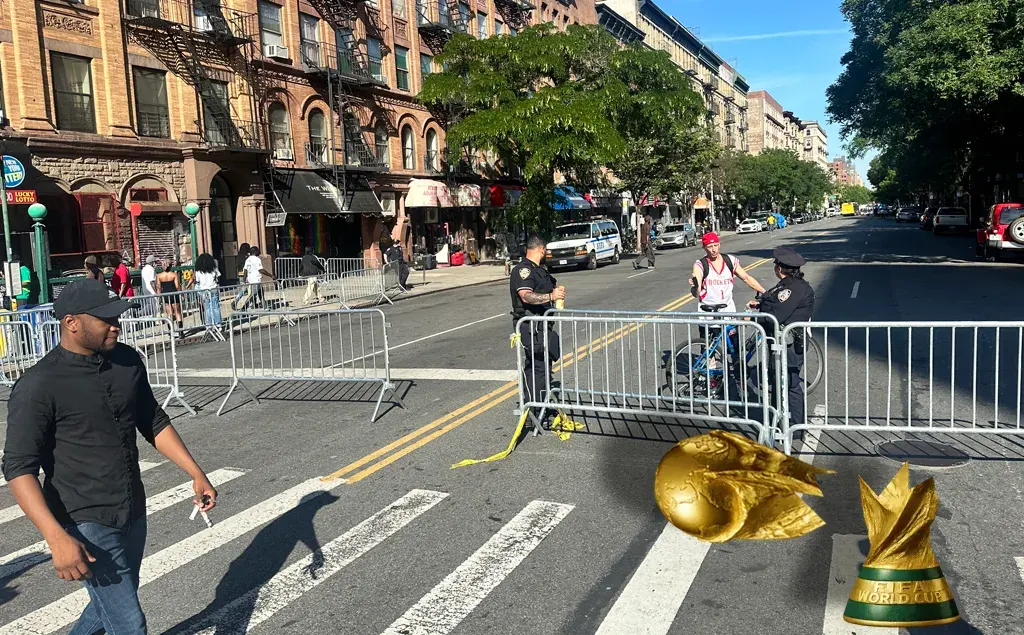
Recent events involving the viewing of international soccer matches have brought into focus the New York Police Department’s (NYPD) approach to managing public spaces, particularly in diverse neighborhoods. An incident reported on W. 116th Street in Harlem, often referred to as Little Senegal, has prompted questions about the necessity and proportionality of police tactics employed during what were otherwise community celebrations of sport.
The New York Urbanism Desk is examining this situation to understand the impact of such policing on public life and equitable access to urban spaces. While official city policies often encourage the use of public areas for community engagement, the methods used to manage these gatherings can significantly alter the experience for residents.
Crowd Control Concerns
The author of the original report described arriving at Keur Coumba, a venue on W. 116th Street, to watch a soccer match. Upon arrival, two blocks of the street were reportedly sealed off by the NYPD. Residents were allegedly subjected to checkpoints and questioning, with individuals deemed to lack a sufficient reason for being present being turned away. This level of control was implemented despite an estimated crowd of no more than 100 people spread across the sidewalks, primarily patrons of local businesses and residents.
When questioned about the street closure, an officer cited “crowd control” as the reason. However, the author observed that the gathering did not appear to constitute a crowd requiring such stringent measures. The dispersal of the attendees after the match was described as orderly, with individuals returning to their homes or places of work.
Questions of Equity and Policing
A significant point of concern raised is the differential application of such policing tactics. The author noted the absence of similar NYPD presence and street closures at other viewing locations, such as the German House of Soccer in Chelsea and viewing events in Park Slope during the American team’s matches. This observation has led to an inquiry into why a neighborhood with a significant West African population, celebrating a sport popular within that community, was subject to a level of policing that felt excessive and potentially discriminatory.
The report highlights a broader debate about how public spaces should be policed. The use of barricades and checkpoints, particularly when perceived as intrusive, can undermine the very sense of community and openness that public spaces are intended to foster. The comparison is drawn to the recent celebrations for the New York Knicks, which, despite being a large public event, were characterized by a more open and less restrictive atmosphere, allowing the public to “use it without feeling like prisoners in their own communities.”
Impact on Public Realm
The management of public space directly influences its accessibility and usability for residents. When police tactics create barriers, question the presence of individuals, or require specific justifications for being in a public area, it can deter participation in community events and diminish the perceived ownership of these spaces by the local populace. This is particularly relevant in areas like Harlem, where public spaces are vital for social cohesion and cultural expression.
The London Urbanism Desk is committed to reporting on how city policies and their implementation affect the lived experience of urban dwellers. The policing of public spaces, especially during events that bring communities together, is a critical aspect of urban governance that warrants careful examination. The question remains: how can public safety be ensured without compromising the freedom and inclusivity of public spaces?
Future Scrutiny and Local Context
The original report indicates an intention to seek further information and ask questions regarding the NYPD’s rationale behind these specific control measures. This proactive approach to accountability is crucial for understanding the operational policies of law enforcement agencies and their impact on civil liberties and public life.
While this report originates from New York City, the underlying issues of public space management and policing tactics are relevant to urban centers globally, including London. The London Urbanism Desk will continue to monitor similar situations and explore how different cities approach the balance between public order and public access. The principles of community engagement and the right to assemble freely in public spaces are fundamental to a healthy urban environment.
Key facts
| Aspect | Details |
|---|---|
| Incident Location | W. 116th Street, Harlem, New York City |
| Event | Viewing of international soccer matches |
| Police Action | Street closures, checkpoints, questioning of individuals |
| Stated Reason | Crowd control |
| Author’s Observation | Minimal crowd size, orderly dispersal, perceived differential policing |
| Core Issue | Policing of public space during community celebrations |
Source: Streetsblog NYC, https://nyc.streetsblog.org/2026/06/17/wednesdays-headlines-blocked-party-edition
Fuente
Streetsblog NYC Publicacion original: 2026-06-17T04:01:00+00:00
Related updates

When zoning reform meets private covenants: the HOA obstacle to backyard cottages
As more US cities rewrite zoning rules to allow accessory dwellings, private homeowners’ association covenants remain a barrier that reform alone cannot…
Read update
Seattle-Area Race Highlights Diverging Approaches to Housing, Transit and Tech Taxation
A Washington State legislative race in the 32nd District pits incrementalism against urgency on housing supply, transit funding and tech regulation, with…
Read update
New York court ruling on sanctuary policies carries implications for city-level immigration enforcement across the US
A federal judge has dismissed the Trump administration’s attempt to override New York City’s restrictions on immigration enforcement cooperation, citing state sovereignty.…
Read update
Automated license plate readers raise privacy, contract and oversight questions for UK cities
A new US-focused analysis of automated license plate recognition cameras highlights contract, privacy and oversight issues that London boroughs and Transport for…
Read update