QueensWay Park Project Proceeds, Dimming Hopes for QueensLink Transit
New York City's Mayor Mamdani administration has formally rejected proposals to incorporate transit into the QueensWay park project, opting instead to fully fund the park's development and signalling a significant setback for the QueensLink passenger rail reactivation initiative.
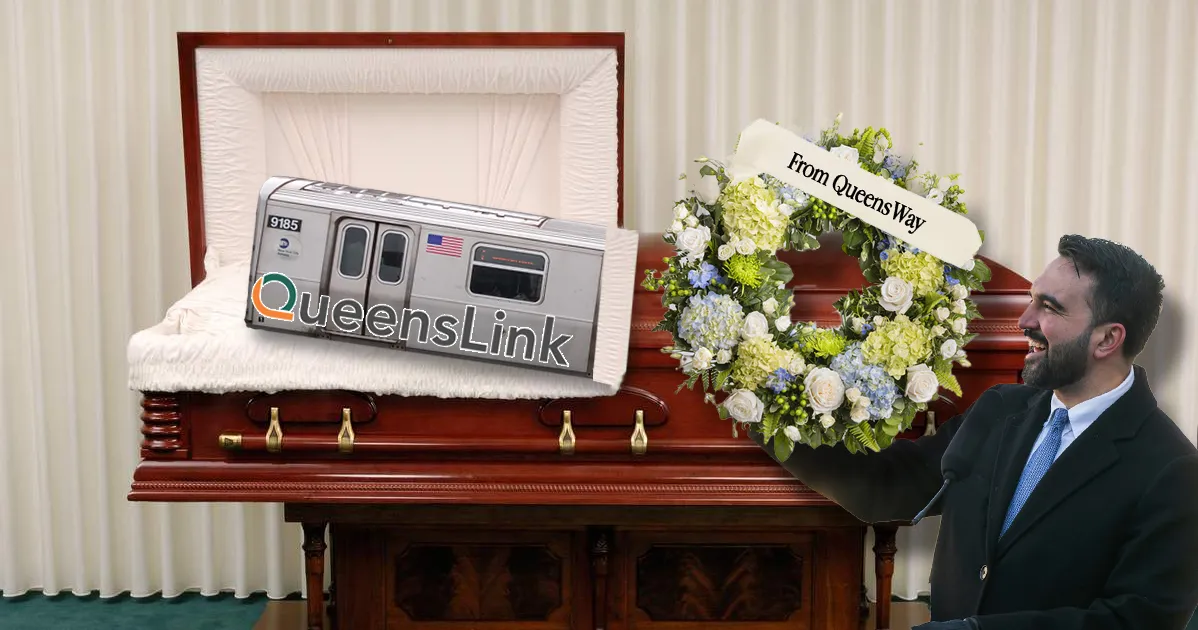
New York City Mayor Mamdani’s administration has officially closed the door on incorporating transit into the planned QueensWay park, a decision that marks a significant blow to advocates for the QueensLink passenger rail reactivation project. The administration has informed QueensLink proponents that it will proceed with funding the park’s construction, effectively burying the long-discussed transit initiative.
Mayor’s Administration Confirms Park Funding
Advocates for QueensLink received a definitive “no” from city officials regarding their push to integrate a transit component into the QueensWay project. Mikelle Adgate, chief of staff to Deputy Mayor of Operations Julia Kerson, informed QueensLink representatives that the administration is moving forward with the QueensWay Phase One, citing their review of the initial business case study and provided statistics.
“After reviewing your initial business case study and the statistics that you provided, we are moving forward with Queensway Phase One,” stated Noelle Hunter, a spokesperson for QueensLink. The administration maintains that the park’s construction will not preclude future transit service, a claim that proponents of QueensLink dispute.
QueensLink organizers had hoped to persuade City Hall to “pause” the park’s development, seeking to allocate funds for a transit component or to thoroughly assess the feasibility of integrating a rail line. The Mamdani administration has budgeted $43 million for the park’s construction in its executive budget.
QueensLink advocates argue that once the park is established, it will become practically impossible to implement a rail service along the abandoned rail line. Their concerns are rooted in precedents from other cities, such as the Purple Line in Maryland and the Beltline in Georgia, where similar rail-to-trail projects reportedly increased costs or obstructed proposals for transit reactivation.
“We asked to lockbox the current funds for QueensWay, basically putting a pause on the project, so that we can incorporate some sort of transit component, or until we know the details of how a transit addition to the project would really work,” Hunter explained.
Projected Ridership and Impact
A recent study by QueensLink supporters estimated that nearly 75,000 people per day would utilize the QueensLink, potentially replacing approximately 15,000 daily car trips in the area. This projected impact, along with historical examples of transit integration challenges in converted rail corridors, was presented to the city. However, these arguments were not sufficient to sway the mayoral representative.
The decision represents a reversal for Mayor Mamdani, who had previously supported QueensLink both as a member of the Assembly and during his mayoral campaign. This change in stance has come as a surprise to the proposal’s proponents.
“Obviously, we’re not pleased. We really expected a lot more from this mayor, especially since transit has been such a big component of his policy platform,” said Hunter.
Conflicting Visions for the Right-of-Way
The administration’s assertion that “building the park now won’t block transit in the future” echoes the previous administration’s stance under former Mayor Eric Adams, who had allocated funds for the design and initial construction of the QueensWay’s Metropolitan Hub phase from Metropolitan Avenue to Union Turnpike.
However, critics argue that the current park designs place it directly in the path of the proposed train route. Recent designs for the Metropolitan Hub show the park occupying areas that would be essential for the train project. Any future transit addition on this route may necessitate the closure, at least temporarily, of sections of the park.
The proposed QueensLink design envisioned extending the M train from the Rego Park-63 Drive station to Beach 116th Street-Rockaway Park. Advocates proposed running the train underground from Rego Park, surfacing just north of Union Turnpike, within the planned Phase One of the QueensWay. Their vision included integrating park space both above and alongside the rail line.
City Hall’s Perspective
A spokesperson for Mayor Mamdani, Jeremy Edwards, stated that the city remains committed to expanding green and open spaces. “The City remains committed to expanding green and open space across the boroughs and is actively exploring all available funding options to make that a reality,” Edwards said. He confirmed the administration’s dedication to completing the Metropolitan Hub phase of the QueensWay, with final design expected by mid-2026 and construction commencing by the end of 2026.
This decision is the latest in a series of obstacles for QueensLink, which has historically struggled to gain traction with key city and state decision-makers. The Metropolitan Transportation Authority (MTA) has consistently shown little enthusiasm for the project. In 2019, the MTA completed a required study on reactivating the rail service but subsequently shelved it. QueensLink supporters have accused the MTA of inflating project costs to make it seem unfeasible.
While the MTA included a brief consideration of QueensLink in its 20-Year Needs Assessment in 2023, it again concluded that the project did not offer sufficient value for money. MTA Chairman and CEO Janno Lieber has acknowledged the advocates’ thorough research but has not indicated any interest from the MTA in pursuing the proposal.
Key facts
| Aspect | Details |
|—|—|
| Project Focus | QueensWay Park vs. QueensLink Transit |
| Administration Stance | Prioritizing QueensWay Park development |
| QueensLink Status | Decision made not to incorporate transit |
| QueensWay Phase One Funding | $43 million allocated by Mayor Mamdani |
| QueensWay Construction Timeline | Final design by mid-2026, construction by end of 2026 |
The conflict between developing extensive parkland and preserving or creating transit corridors highlights a common tension in urban planning. While green spaces are vital for urban livability and climate resilience, the efficient movement of people is equally critical for a city’s economic health and accessibility. The decision to proceed with the QueensWay park without a transit component raises questions about the long-term transportation needs of Queens and the potential for future retrofitting should the city’s priorities shift. The physical manifestation of the park, especially in its initial phases, could present significant engineering and financial challenges for any future transit ambitions along this corridor.
Source: Streetsblog NYC – https://nyc.streetsblog.org/2026/05/29/mamdani-officially-turns-his-back-on-the-queenslink
Key facts
| Point | Detail |
|---|---|
| Source | Streetsblog NYC |
| Date | 2026-05-29T04:03:00+00:00 |
| Topic | Mamdani Officially Buries The QueensLink |
Fuente
Streetsblog NYC Publicacion original: 2026-05-29T04:03:00+00:00
Related updates
Seattle-Area Race Highlights Diverging Approaches to Housing, Transit and Tech Taxation
A Washington State legislative race in the 32nd District pits incrementalism against urgency on housing supply, transit funding and tech regulation, with…
Read update
New York court ruling on sanctuary policies carries implications for city-level immigration enforcement across the US
A federal judge has dismissed the Trump administration’s attempt to override New York City’s restrictions on immigration enforcement cooperation, citing state sovereignty.…
Read update
Automated license plate readers raise privacy, contract and oversight questions for UK cities
A new US-focused analysis of automated license plate recognition cameras highlights contract, privacy and oversight issues that London boroughs and Transport for…
Read update
Oregon’s “fix it first” dilemma: what London’s transport planners can learn from a revolt against megaprojects
Surveys show Oregonians overwhelmingly want existing roads repaired before new megaprojects are funded, and trust in the state’s transport agency has collapsed.…
Read updateWiki relacionada

Urban Planning Terms: Density, Public Realm and Transit-Oriented Development
A living glossary for terms that appear again and again in planning and development stories.
Read update