
Scooter Manufacturer Adds Safety Warning After Deadly Bridge Crash
Teverun, maker of a high-speed electric scooter involved in a fatal collision, has updated its website with a disclaimer after public outcry and media coverage.
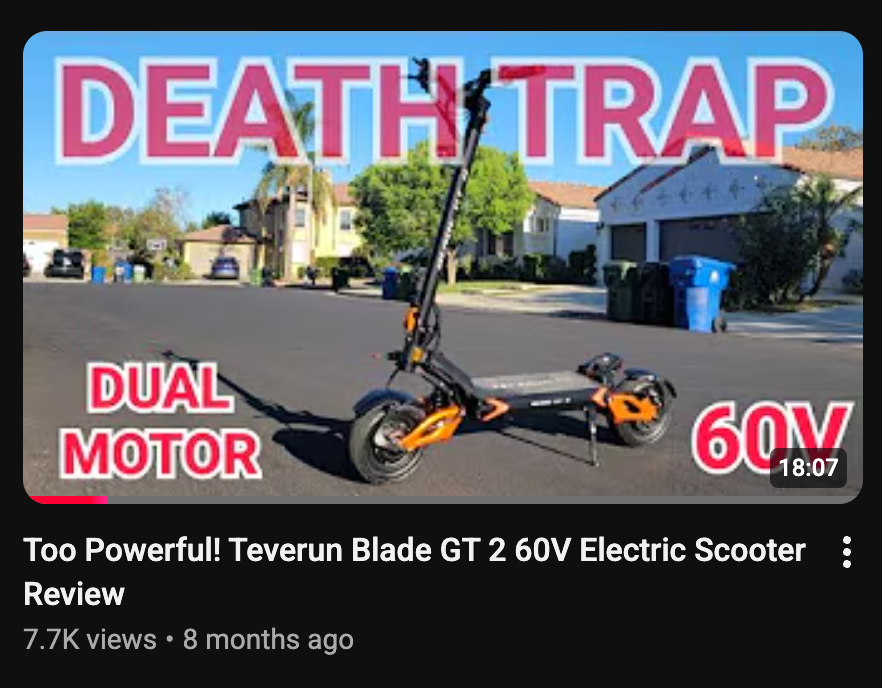
The manufacturer of a high-speed electric scooter involved in a recent fatal collision on New York City’s Queensboro Bridge has added a warning to its website. Teverun, the company behind the Blade GT II model, has updated its site with a disclaimer about speed limits and intended use after public pressure and media attention following the May 28th crash that killed two riders.
The incident involved Francis Delvalle, who was riding a Teverun Blade GT II, and Dmytro Stechenko. Both were killed when they collided head-on on the bridge’s bike path. Streetsblog NYC reported that the scooter being ridden by Delvalle was an illegal stand-up electric scooter, not permitted on New York City streets or bike paths.
Website Disclaimer
Following the crash and subsequent media coverage, Teverun has added a notice to its website stating: “All TEVERUN scooters are shipped with a speed limit of 25 km/h [15 miles per hour] for public roads. Unrestricted mode is for private or off-road use only. Always comply with local laws and wear protective gear.” This disclaimer appears as fine print at the top of the webpage.
Legal Experts and Public Reaction
Legal advocates suggest the disclaimer may be an attempt by the company to shift liability to consumers. Peter Beadle, a lawyer specializing in bicycle and safe-streets advocacy, commented that the warning “could be a bit of an acknowledgement that these scooters are dangerous on the roads at higher speeds.”
The addition of the warning followed public comments on Streetsblog’s reporting, where users highlighted the dangers of such scooters. Comments included phrases like “You will die and kill someone else too” and “Perfect killing machine.”
Marketing Practices for High-Speed Scooters
The article notes a common practice among electric scooter companies: advertising devices with features that allow for speeds exceeding legal limits, often by offering an “off-road” or “unrestricted” mode. While state vehicle and traffic codes do not always explicitly address mode-shifting capabilities, the wattage of a scooter’s motor is a key factor in its legality. New York State law stipulates that electric-assist bicycles must have motors of 750 watts or less. Scooters capable of higher speeds, especially when unlocked from a restricted mode, invariably possess motors exceeding this limit.
The report cites an example of Ride1Up, a company that markets “moped-style e-bikes.” While these are advertised as Class 2 e-bikes legally capable of reaching 20 mph with a throttle, their motors can be 1,820 watts, significantly exceeding the 750-watt limit and rendering them illegal for road use regardless of mode. Ride1Up’s website clarifies that higher speeds, achievable by unlocking programming for “Off-Road Mode,” are intended for private property only.
Challenges for Enforcement
Distinguishing between legal electric bikes and illegal e-scooters or e-motos can be difficult for law enforcement officers at a glance. While European cities with more established e-bike cultures and dedicated infrastructure may face fewer such issues, the situation in New York presents a challenge. The city’s own educational materials specify a maximum speed capability of 20 miles per hour for stand-up electric scooters.
Despite the added disclaimer, critics argue that the scooter’s marketing still emphasizes high speeds and aggressive performance, contradicting the safety message. The Teverun website continues to describe the scooter as “built for street dominance” and highlights its ability to handle uneven roads, steep inclines, and urban obstacles with ease, which proponents of the warning label argue is marketing for speeds far exceeding the 15 mph limit.
Key facts
| Feature | Detail |
|---|---|
| Scooter Model | Teverun Blade GT II |
| Reported Fatal Crash Location | Queensboro Bridge bike path, New York City |
| Manufacturer’s Added Warning | Speed limit of 25 km/h for public roads; unrestricted mode for private/off-road use only. |
| Legal Limit for Electric Assist Bikes (NY State) | 750 watts maximum motor power. |
| City’s Max Speed for Stand-Up Scooters | 20 miles per hour. |
The incident and the manufacturer’s response highlight ongoing challenges in regulating increasingly powerful personal electric mobility devices. The marketing of high-speed capabilities, coupled with the potential for easy modification, creates a complex environment for urban safety and enforcement. The Teverun case underscores the need for clearer regulations and more robust enforcement mechanisms to ensure that new mobility technologies contribute positively to urban environments without compromising public safety.
Source: Streetsblog NYC (https://nyc.streetsblog.org/2026/06/02/death-trap-scooter-maker-adds-warning-to-website-after-deadly-bridge-crash)
Fuente
Streetsblog NYC Publicacion original: 2026-06-02T04:03:00+00:00
Related updates

When zoning reform meets private covenants: the HOA obstacle to backyard cottages
As more US cities rewrite zoning rules to allow accessory dwellings, private homeowners’ association covenants remain a barrier that reform alone cannot…
Read update
Seattle-Area Race Highlights Diverging Approaches to Housing, Transit and Tech Taxation
A Washington State legislative race in the 32nd District pits incrementalism against urgency on housing supply, transit funding and tech regulation, with…
Read update
New York court ruling on sanctuary policies carries implications for city-level immigration enforcement across the US
A federal judge has dismissed the Trump administration’s attempt to override New York City’s restrictions on immigration enforcement cooperation, citing state sovereignty.…
Read update
Automated license plate readers raise privacy, contract and oversight questions for UK cities
A new US-focused analysis of automated license plate recognition cameras highlights contract, privacy and oversight issues that London boroughs and Transport for…
Read update