
Queensboro Bridge Lane Conversion Proposed Amidst Declining Car Traffic and Rising Cyclist Numbers
Advocates are calling for a motor vehicle lane on the Queensboro Bridge to be converted to a dedicated cycle path, citing a significant drop in car usage and a substantial increase in cycling.
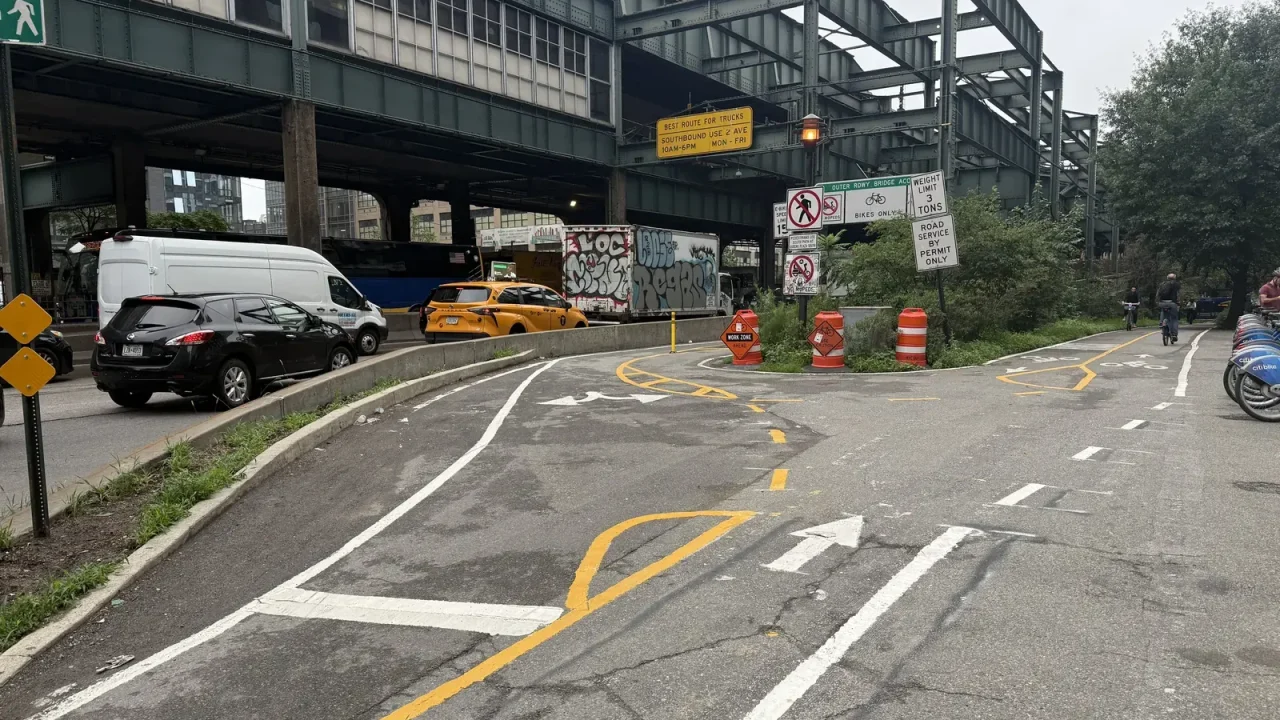
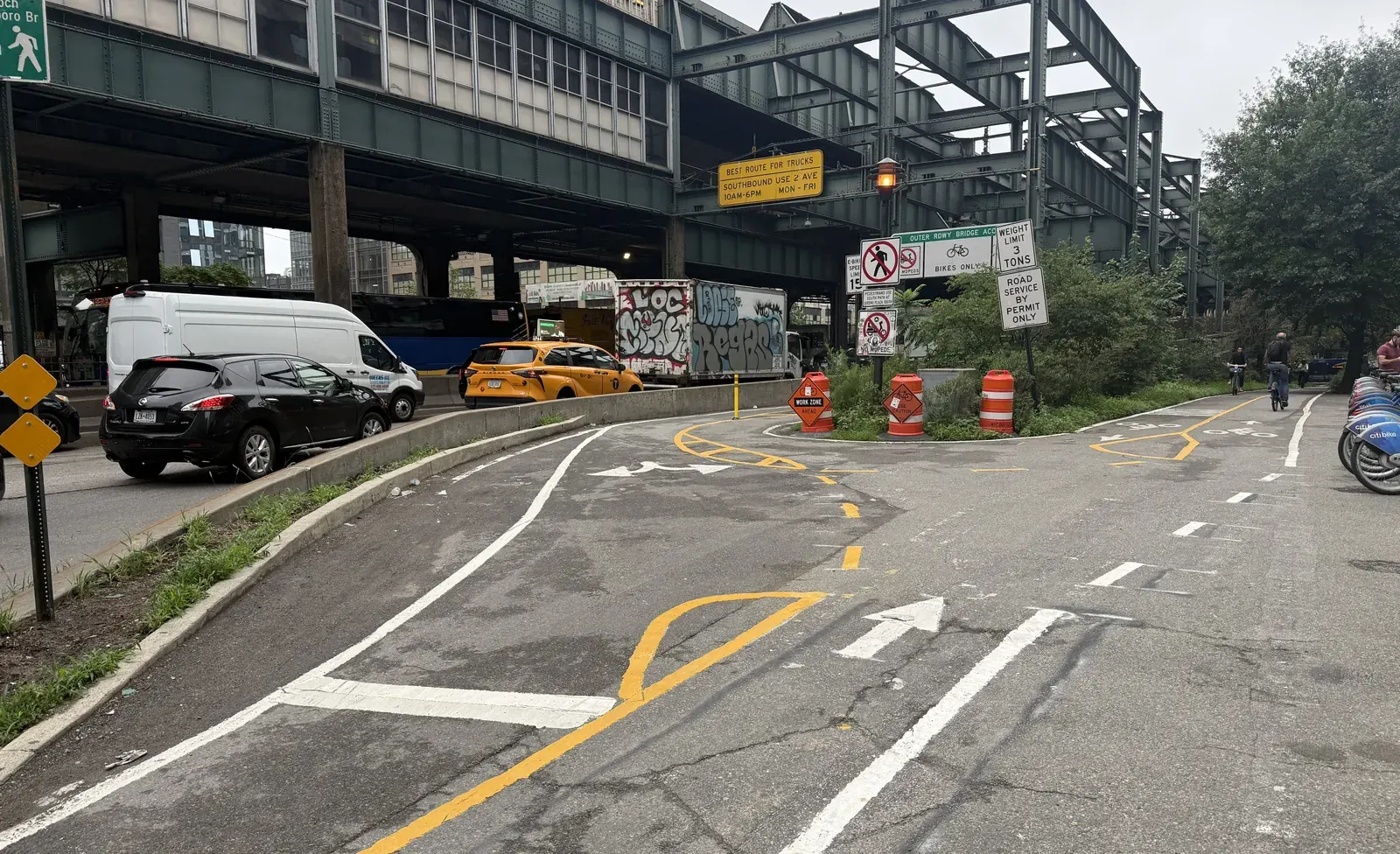
Advocates are urging New York City officials to repurpose one of the existing motor vehicle lanes on the Queensboro Bridge into a dedicated cycle lane. This proposal comes in response to a marked decrease in car traffic on the span, alongside a dramatic increase in the number of cyclists utilizing the bridge.
Traffic Declines on the Queensboro Bridge
Recent data from the New York Metropolitan Transportation Council (NYMTC) reveals a significant reduction in motor vehicle traffic on the Queensboro Bridge. Between 2024 and 2025, daily vehicle usage on the bridge fell by 11.7 percent. Specifically, NYMTC’s latest quarterly traffic study indicated that in the fourth quarter of 2025, an average of 121,629 motor vehicles used the bridge daily, a decrease from 137,768 vehicles per day during the same period in 2024.
This reduction is particularly pronounced on lanes leading into or out of Manhattan’s central business district, an area now subject to congestion pricing tolls. Manhattan-bound traffic saw a decline of 24 percent, dropping from 48,775 vehicles per day in 2024 to 37,067 in 2025. Similarly, Queens-bound traffic decreased by 22.7 percent, from 73,436 vehicles per day in 2024 to 56,772 in 2025.
An increase in traffic was noted on the northbound ramp of the upper level, which allows drivers to exit onto 62nd or 63rd Street. This ramp saw traffic surge from 15,556 drivers in 2024 to 27,790 in 2025, suggesting that a portion of drivers are avoiding the congestion zone and its associated tolls.
Cycling Traffic Surges
In stark contrast to the decline in car traffic, cycling on the Queensboro Bridge has experienced substantial growth. Even when cyclists shared the North Outer Roadway with pedestrians, the annual number of cyclists increased by 74.5 percent between 2019 and 2024, rising from 1,212,391 to 2,115,228. In 2025, over two million cyclists used the bridge. Furthermore, bike traffic in April and May of 2026 was reported to be higher than in the same months of 2025, despite a harsh winter.
Opportunity for Infrastructure Redesign
Experts suggest that the combined trends of reduced car traffic and increased cycling present a prime opportunity for the Department of Transportation to enhance cycling infrastructure on the bridge. Jon Orcutt, a former bike planner for the Bloomberg and de Blasio administrations, stated that significant changes in traffic volumes warrant a reassessment of how infrastructure is utilized. He noted that the city is already expanding bike lanes across Manhattan due to demand.
The North Outer Roadway was converted to a cycling-only lane last year. However, the high volume of cyclists, using various types of bicycles and traveling at different speeds, still leads to conflicts. An incident earlier this year involving a cyclist and an electric scooter operator resulted in a fatal crash on the existing two-way lane.
Converting a motor vehicle lane would allow the city to create two dedicated lanes for cyclists on the bridge, one for inbound and one for outbound traffic. This would provide more space and potentially improve safety for all users. Alexa Sledge, a spokesperson for Transportation Alternatives, highlighted that the current lane is narrow, making passing hazardous. She believes doubling its width would significantly reduce conflicts.
Limited Options for Queens Cyclists
Sledge and Orcutt also pointed out that the Queensboro Bridge serves as the primary crossing for cyclists traveling between Manhattan and Queens. Unlike Brooklyn residents who have multiple bridge options, cyclists heading to Queens have limited alternatives. A petition by Transportation Alternatives underscores this disparity, noting that drivers have 26 lanes across the Queensboro Bridge, the Queens-Midtown Tunnel, and the Triborough Bridge connecting Queens to Manhattan, while cyclists share just half of a single lane on the North Outer Roadway.
Future Traffic Reductions and Infrastructure Potential
The number of vehicles using the main lanes of the Queensboro Bridge is expected to decrease further with the planned increases in congestion pricing. The toll is set to rise to $12 in 2028 and $15 in 2030, which is anticipated to further discourage drivers from entering Manhattan. This increasing capacity on the bridge could provide additional justification for installing a separated bike lane on the roadbed, a solution already implemented on the Brooklyn Bridge. Orcutt suggested that the upcoming toll hikes present a chance for even more capacity to be freed up on these bridges.
Key facts
| Feature | Detail |
|---|---|
| Car Traffic Reduction (2024-2025) | 7 percent |
| 2025 Daily Vehicle Count | 121,629 |
| 2019-2024 Cycling Increase | 5 percent |
| Current Cycling Traffic (2025) | Over 2 million |
The proposed lane conversion directly addresses the changing usage patterns of the Queensboro Bridge, aiming to create a safer and more efficient environment for the growing number of cyclists. This initiative could serve as a model for other urban infrastructure adaptations driven by shifts in transportation demand and policy.
Source: Streetsblog NYC, https://nyc.streetsblog.org/2026/07/15/fewer-cars-on-queensboro-bridge-means-its-time-to-take-a-lane-for-increasing-cyclists
Fuente
Streetsblog NYC Publicacion original: 2026-07-15T04:05:00+00:00
Related updates

When zoning reform meets private covenants: the HOA obstacle to backyard cottages
As more US cities rewrite zoning rules to allow accessory dwellings, private homeowners’ association covenants remain a barrier that reform alone cannot…
Read update
Seattle-Area Race Highlights Diverging Approaches to Housing, Transit and Tech Taxation
A Washington State legislative race in the 32nd District pits incrementalism against urgency on housing supply, transit funding and tech regulation, with…
Read update
New York court ruling on sanctuary policies carries implications for city-level immigration enforcement across the US
A federal judge has dismissed the Trump administration’s attempt to override New York City’s restrictions on immigration enforcement cooperation, citing state sovereignty.…
Read update
Automated license plate readers raise privacy, contract and oversight questions for UK cities
A new US-focused analysis of automated license plate recognition cameras highlights contract, privacy and oversight issues that London boroughs and Transport for…
Read updateWiki relacionada

Urban Planning Terms: Density, Public Realm and Transit-Oriented Development
A living glossary for terms that appear again and again in planning and development stories.
Read update