
BART’s Rail Operations Controller Highlights Transit’s Crucial Role and Funding Needs
A profile of a BART rail operations controller reveals the intricate work of keeping a major transit system running and underscores the critical need for public investment.
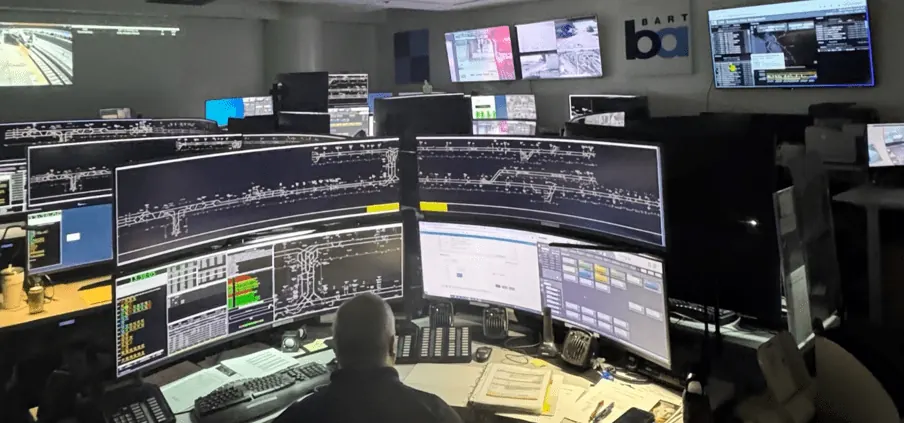
Behind the scenes of the Bay Area Rapid Transit (BART) system, a dedicated team works to ensure the safe and efficient movement of millions of passengers. Kelly Robinson, a Rail Operations Controller (ROC) with 17 years of experience at BART, likens her role to that of an air traffic controller, overseeing the complex dance of trains across the system. Her perspective offers a unique insight into the daily challenges and the profound importance of public transit.
The Heart of Operations Control
Robinson’s role in BART’s Operations Control Center (OCC) places her at the nerve center of the transit network. ROCs are responsible for the safety of passengers, employees, and equipment, managing all aspects of the system outside of the railyards. While train operators are the eyes on the ground, ROCs are described as the “beating heart and the brains,” tasked with rectifying errors, maintaining schedules, and responding to incidents with speed and precision.
“The thing that I like best about my job is that I’m always challenged,” Robinson stated. “We have to keep navigating our way through whatever the system is throwing at us that day.” This constant need for problem-solving and adaptability defines the high-pressure environment of the OCC, where ROCs monitor numerous screens displaying the real-time status of trains.
Responding to Emergencies
When disruptions occur—be it a train breakdown, a switching issue, a medical emergency, or police activity—ROCs are the first responders, coordinating with external emergency services to provide rapid assistance. The demanding nature of this work, often involving 12-hour shifts and frequent overtime that can lead to 60-hour workweeks, contributes to the position being understaffed.
Robinson described the critical process of managing train flow during an incident: “Once you have an occurrence like that, we can’t manage that many trains in that area. We have to get creative and figure out how to get people where they’re going with a big hurdle in their way.” Her priorities include ensuring the airport remains accessible and rerouting trains to minimize passenger disruption, focusing on isolating the incident area to prevent further complications. “What people don’t know is how important it is for us to react to isolate an incident area,” she explained. “Her goal is always to make the incident area as small as possible, which means keeping other trains out of harm’s way.”
The Vital Role of Transit Funding
Robinson, a lifelong BART rider and employee, deeply understands transit’s impact on daily life. She is a vocal advocate for the Connect Bay Area ballot measure, a crucial funding initiative for BART. She notes that without this funding, BART could face a significant decline, potentially leading to 60-minute headways between trains and the closure of many stations. “Not having the funding would send us in a spiral in the wrong direction,” Robinson warned.
Looking to the Future
Robinson envisions a future for BART that includes 10-minute headways and the integration of advanced technology, reflecting the system’s origins as a state-of-the-art innovation. “When BART was created, it was state of the art. The entire world was reveling in this transit system,” she commented. “With our extensions, I would have liked to see all-new technology.” She expressed a desire for transit development to receive the same level of investment in innovation as other sectors, such as space exploration. While the Connect Bay Area measure may not match SpaceX-level funding, it represents a significant step towards enhancing transit services in the Bay Area.
Key facts
| Aspect | Detail |
|---|---|
| Role | Rail Operations Controller (ROC) at BART |
| Experience | 17 years at BART, 30 years with the agency including family history |
| Key Responsibilities | System safety, train scheduling, incident response, traffic management |
| Critical Need | Funding through the Connect Bay Area ballot measure for service maintenance |
| Future Vision | 10-minute headways, advanced technology integration, sustained innovation |
Source: Streetsblog SF – https://sf.streetsblog.org/2026/06/15/barts-air-traffic-controller-has-a-unique-view-of-the-importance-of-transit
Fuente
Streetsblog SF Publicacion original: 2026-06-15T20:39:22+00:00
Related updates
Seattle-Area Race Highlights Diverging Approaches to Housing, Transit and Tech Taxation
A Washington State legislative race in the 32nd District pits incrementalism against urgency on housing supply, transit funding and tech regulation, with…
Read update
New York court ruling on sanctuary policies carries implications for city-level immigration enforcement across the US
A federal judge has dismissed the Trump administration’s attempt to override New York City’s restrictions on immigration enforcement cooperation, citing state sovereignty.…
Read update
Automated license plate readers raise privacy, contract and oversight questions for UK cities
A new US-focused analysis of automated license plate recognition cameras highlights contract, privacy and oversight issues that London boroughs and Transport for…
Read update
Oregon’s “fix it first” dilemma: what London’s transport planners can learn from a revolt against megaprojects
Surveys show Oregonians overwhelmingly want existing roads repaired before new megaprojects are funded, and trust in the state’s transport agency has collapsed.…
Read updateWiki relacionada

Urban Planning Terms: Density, Public Realm and Transit-Oriented Development
A living glossary for terms that appear again and again in planning and development stories.
Read update