
Bike Safety Debate: Why the ‘Dutch Reach’ Alone Falls Short, and What London Can Learn
A recent op-ed argues that the ‘Dutch reach’ is a misplaced focus for bike safety, urging instead for protected infrastructure and cultural shifts – a debate that directly applies to London’s ongoing cycling safety efforts.
A recent op-ed in Streetsblog Chicago argues that the ‘Dutch reach’ – the technique of opening a car door with the opposite hand to force the driver to look over their shoulder – is a misplaced effort that fails to address the root causes of road danger. The piece, by Chris Ridgeway, contends that true bike safety requires protected infrastructure and cultural shifts. While the article is set in Chicago, the debate resonates strongly in London, where dooring incidents remain a persistent risk and where the balance between individual behaviour change and systemic design is a central question for transport planners.
The Argument Against the Dutch Reach
Ridgeway writes that in the wake of the deaths of two transportation planners while cycling, admonishing drivers to use the Dutch reach is a “misplaced effort” that does not solve the structural problems of road safety. He argues that the technique places the burden on individuals rather than on the design of streets and the enforcement of safe speeds. The op-ed highlights that the Netherlands is safe for cyclists for myriad reasons, the Dutch reach being only one small tool in a much larger toolbox. “On-street bike infrastructure is more than just cyclist protection,” Ridgeway writes, quoting design researcher Don Norman on the concept of “affordances” – physical environments that, if designed properly, human psychology understands how to use without instruction. From doorknobs to protected bike lanes, humans need to perceive possibility before action.
Key facts
| Fact | Detail |
|---|---|
| Op-ed author | Chris Ridgeway |
| Publication | Streetsblog Chicago |
| Central argument | Dutch reach is a small tool; true safety requires protected infrastructure and a cultural shift |
| Relevance to London | London’s Vision Zero strategy relies on both infrastructure and behaviour change; dooring remains a risk despite expanded cycle lanes |
London’s Infrastructure Approach
London has invested heavily in protected cycle infrastructure over the past decade, with routes such as Cycle Superhighways and Quietways designed to separate cyclists from motor traffic. Yet dooring – a collision caused when a car door is opened into the path of a cyclist – remains a hazard, particularly on streets where cycle lanes lie between parked cars and moving traffic. Transport for London’s Vision Zero action plan, adopted in 2018, targets the elimination of all deaths and serious injuries on the capital’s roads by 2041, and has prioritised junction redesign, speed reduction and protected cycle lanes. The Dutch reach has been promoted by safety organisations in London as a simple habit for drivers and passengers, but the op-ed’s critique suggests that such campaigns may be insufficient without concurrent design changes.
The Role of Design and Affordances
The op-ed’s emphasis on “affordances” echoes a growing body of urban design thinking that argues built environment shapes behaviour more reliably than signs or education. In London, the design of cycle lanes varies: some are fully kerb-protected, others are painted lines with wands or bollards, and some are advisory lanes with no physical separation. The affordance of a protected lane – its clear visual and physical cue that a cyclist has a dedicated space – is precisely what Ridgeway calls for. The article argues that drivers should not need to remember a special door-opening technique; instead, the street design should make it impossible or unlikely for a door to open into a cyclist’s path. This can be achieved through measures such as buffer zones, cycle lanes positioned away from the door zone, or parking bays that are set back from the cycle track.
A Cultural Shift Beyond Individual Habits
Ridgeway’s broader point is that road safety depends on a cultural shift that normalises cycling and prioritises people over vehicles. London has made progress in that direction: cycling levels have grown significantly, and the recent expansion of the Ultra Low Emission Zone and the introduction of low-traffic neighbourhoods have reduced car dominance in some areas. However, the debate over the Dutch reach highlights a tension between quick behavioural fixes and slower, more expensive infrastructure changes. The op-ed suggests that insisting on the Dutch reach as a primary safety message may actually distract from the need for systemic redesign. For London, this means that Vision Zero cannot rely on education alone; it must continue to invest in physical separation, protected junctions and speed reduction.
Next Steps for London’s Cycling Safety
The op-ed’s message is timely as London prepares for further cycling infrastructure upgrades under the Mayor’s Transport Strategy. The next round of Cycle Superhighway improvements, the rollout of the London Cycling Design Standards and the ongoing review of bus stop and parking layouts on cycle routes will determine whether the capital moves beyond the Dutch reach mindset. For planners, the key takeaway is that safety campaigns should complement – not substitute for – design changes. For residents, the message is that the most effective way to avoid dooring is to ride on streets where the lane is physically separated from parked cars, and to advocate for such infrastructure in their neighbourhoods.
Source: Planetizen News, reporting on a Streetsblog Chicago op-ed by Chris Ridgeway, “Op-ed: True bike safety requires more than the ‘Dutch reach’”, 26 July 2026, https://www.planetizen.com/news/2026/07/138073-op-ed-true-bike-safety-requires-more-dutch-reach
Fuente
Planetizen News Publicacion original: 2026-07-26T14:00:00+00:00
Related updates

Honolulu’s school zone sign failure: what London can learn about speed limit enforcement
Honolulu cut speed limits near schools in 2024 but has yet to update most signs, leaving drivers unaware and enforcement in limbo.…
Read update
Circularity and Design for Disassembly: Could London Construction Learn from the ‘Reusable Building’ Concept?
A recent Common Edge article argues that the construction industry should move away from single-use buildings by adopting circularity and design for…
Read update
Editorial note: Waco cottage court story not publishable on London Urbanism Desk
The Waco cottage-courts signal is off-topic for a London-focused site. This note explains why the story cannot be published and what a…
Read update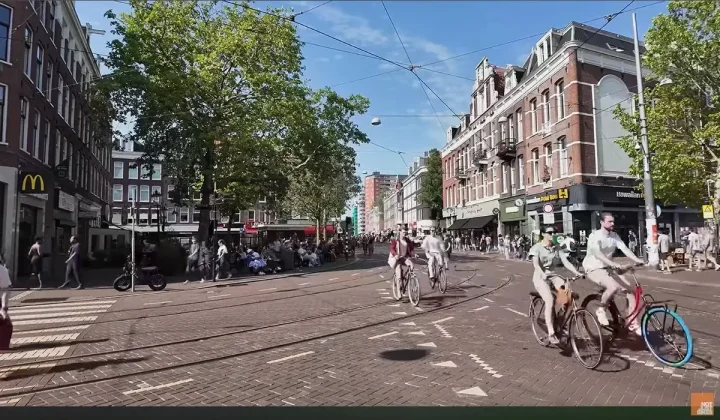
What Amsterdam’s Parking Removal Drive Means for London’s Car‑Lite Ambitions
Amsterdam has removed more than 10,000 on‑street parking spaces since 2019 as part of its car‑lite street plan. For London, where Low…
Read updateWiki relacionada

Urban Planning Terms: Density, Public Realm and Transit-Oriented Development
A living glossary for terms that appear again and again in planning and development stories.
Read update