
What Amsterdam’s Parking Removal Drive Means for London’s Car‑Lite Ambitions
Amsterdam has removed more than 10,000 on‑street parking spaces since 2019 as part of its car‑lite street plan. For London, where Low Traffic Neighbourhoods and parking reforms are often contested, the Dutch capital’s approach offers a long‑term, data‑driven reference point.
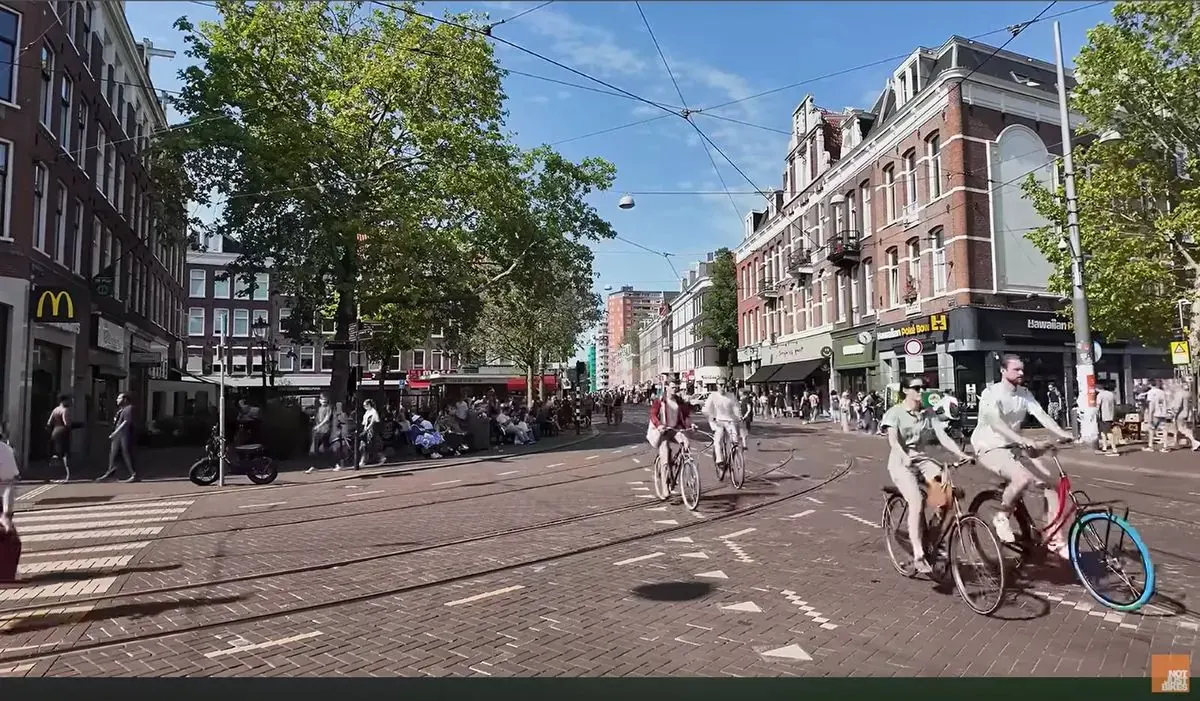
Amsterdam’s deliberate removal of more than 10,000 on‑street parking spaces since 2019, part of its “autoluw” (car‑lite) plan, has reshaped large parts of the city. The Dutch capital now aims to eliminate another 10,000 spaces by 2030, freeing road space for cycle paths, parks, and pedestrian areas. For London, where similar debates over Low Traffic Neighbourhoods (LTNs) and kerbside reform are ongoing, the Amsterdam experience offers a concrete, long‑term case study in how a city can systematically shift street use away from cars.
The Amsterdam model
The plan, announced in 2019, involved not just parking removal but also the installation of modal filters — physical barriers that prevent through‑traffic on residential streets — and the conversion of former car lanes into bike lanes, green verges, and seating areas. According to a video analysis by Jason Slaughter of the urbanism channel Not Just Bikes, the results have been a “remarkable transformation” across the city. The approach is incremental but cumulative: each parking space removed is a small piece of a larger network that makes walking, cycling, and public transport more attractive and safer.
Key facts
| Metric | Amsterdam figure | London comparable |
|---|---|---|
| On‑street parking spaces removed since 2019 | More than 10,000 | No single city‑wide target; boroughs remove spaces on a case‑by‑case basis |
| Target for additional removal by 2030 | Another 10,000 spaces | Not specified in current Mayor’s Transport Strategy |
| Main tools used | Modal filters, lane removal, kerbside reallocation | LTNs, Streetspace, timed loading bays, cycle‑lane conversions |
| Street‑space reallocation outcome | Bike paths, parks, green spaces, seating | Cycle lanes, wider footways, pocket parks, school streets |
London parallels and differences
London’s transport policies have moved in a similar direction under the Mayor’s Transport Strategy, which aims for 80 per cent of trips to be made by active or public transport by 2041. The Streetspace programme, accelerated during the pandemic, introduced temporary cycle lanes, widened footways, and established Low Traffic Neighbourhoods in many boroughs. Parking removal has been a frequent element, though usually on a street‑by‑street or borough‑by‑borough basis rather than under a centrally coordinated, city‑wide target.
A 2024 report from the London Assembly’s Transport Committee noted that while LTNs have reduced traffic in some neighbourhoods, the lack of a consistent kerbside strategy and the political contentiousness of parking removal have slowed progress. Amsterdam’s experience shows that setting a hard metric — such as a specific number of spaces to be removed by a fixed date — can help depoliticise decisions and provide a clear benchmark for residents and businesses.
Challenges and local context
Any direct transfer of the Amsterdam model would face differences in governance, density, and car‑ownership patterns. London’s boroughs have independent control over parking and traffic management, which makes city‑wide targets difficult to enforce. The political cost of removing parking is also higher in areas where car dependency is stronger, such as outer London suburbs. Nonetheless, the Dutch example demonstrates that parking removal, when combined with visible improvements to public space, can build public support over time. Surveys in Amsterdam have shown growing approval for the autoluw policy as the benefits — quieter streets, better air quality, more space for children to play — become tangible.
What London can take away
The most immediate lesson is the value of a long‑term numerical target. London’s current Kerbside Strategy, published in 2023, sets out principles for reallocating kerbside space but does not include a parking‑removal quota. Amsterdam’s 10,000‑space reductions and the follow‑up target of another 10,000 by 2030 provide a clear, measurable commitment that can be tracked and communicated to the public. Planners and campaigners in London may point to this as a precedent for setting similar targets at the borough or regional level.
Conclusion
Amsterdam’s car‑lite street expansion is neither a blueprint to be copied wholesale nor a simple success story — it is a real‑world test of a policy that London has embraced in part but not yet with the same systematic ambition. For anyone following London’s transport and public‑realm debates, the Dutch capital’s progress offers a useful yardstick against which to measure local proposals.
Source: The Urbanist, “Sunday Video: Amsterdam Car‑Lite Streets Grow As Parking Gets Removed”, https://www.theurbanist.org/sunday-video-amsterdam-car-lite-streets-grow-as-parking-gets-removed/
Fuente
The Urbanist Publicacion original: 2026-07-26T14:52:55+00:00
Related updates

Why the predicted Portland ‘Carmaggedon’ never arrived — and what London can learn about traffic evaporation
A month-long closure of a mile-long section of I-5 in Portland was forecast to triple commute times. Instead, morning peak journeys increased…
Read update
What the fall of Angkor reveals about the risks of low-density urban sprawl
A new analysis of the fall of Angkor, the ancient Khmer capital, draws parallels between its sprawling, low-density infrastructure and the vulnerabilities…
Read update
Colorado Data Center Dispute Highlights Gap in Planning Rules and Community Oversight
A proposal for Colorado’s largest data centre in Aurora has sparked debate over planning rules that allow major developments to bypass public…
Read update
London procurement teams face mounting cost and compliance pressures, North American survey suggests
A survey of 100 public-sector procurement professionals across North America finds rising costs and compliance demands straining teams, with 46% still relying…
Read updateWiki relacionada

Urban Planning Terms: Density, Public Realm and Transit-Oriented Development
A living glossary for terms that appear again and again in planning and development stories.
Read update