
I-5 Columbia River Bridge Expansion Faces Funding Hurdles Amidst Local Opposition
A federal green light for the I-5 Interstate Bridge Replacement project has been issued, but significant funding gaps and local disagreements over light rail integration cast doubt on its completion.
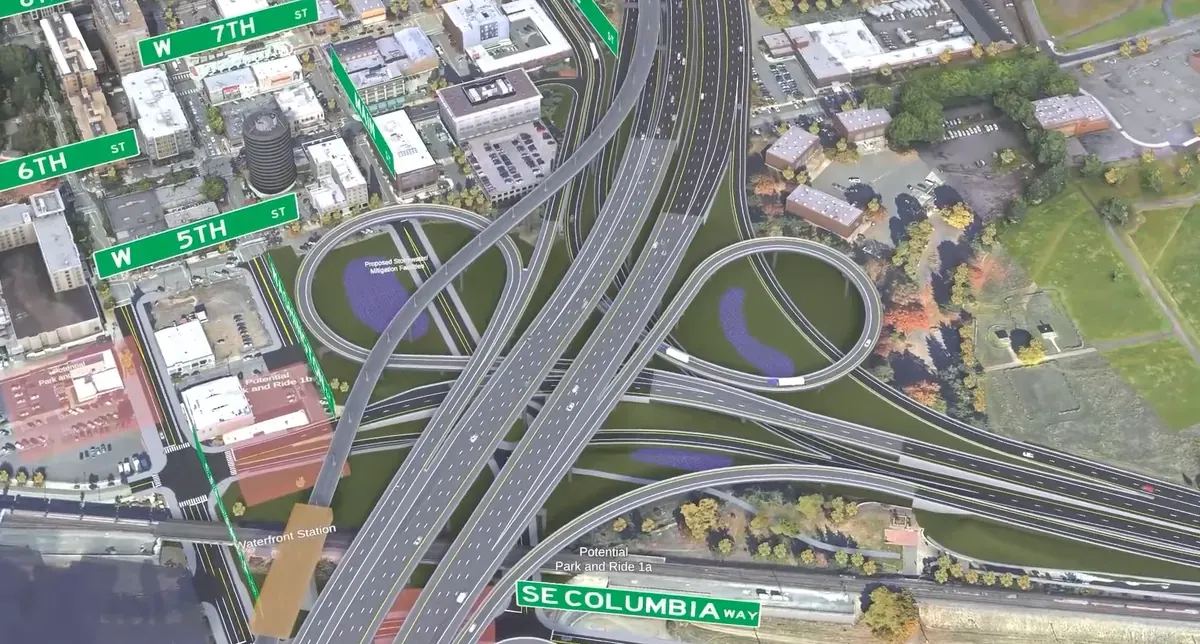
The Interstate Bridge Replacement (IBR) program, a major bi-state infrastructure initiative aiming to replace and widen the I-5 corridor between North Portland, Oregon, and Vancouver, Washington, has achieved a significant milestone with the Federal Highway Administration and Federal Transit Administration jointly issuing an amended Record of Decision. This marks the completion of the project’s federal environmental review. Despite this advancement, the path forward is fraught with considerable challenges, including substantial funding deficits and internal discord regarding the integration of light rail.
Project Phases and Funding Gaps
The IBR project is envisioned as a comprehensive overhaul of a five-mile stretch of I-5, including the aging Columbia River bridges. The officially approved first phase of work is set to encompass a new section of I-5 between Vancouver and Portland’s Hayden Island, the construction of tolling infrastructure, the eventual demolition of the existing bridges, and design work for an extension of TriMet’s MAX Yellow light rail line into Washington State. Crucially, this initial phase will not include any widening of I-5 beyond this designated footprint, nor will it incorporate most of the planned interchange improvements.
The construction of light rail itself remains contingent on the project securing a $1 billion FTA grant, with a decision unlikely before 2030. The current plan is for the bridge to be built as “light rail ready,” with train service not anticipated until 2036 or later. With $5.6 billion currently allocated, including projected future toll revenue, the funding for this first phase appears secure. However, the total estimated cost for the complete corridor overhaul ranges between $13.5 billion and $15.2 billion, highlighting a significant funding gap. Further cost increases could force both Oregon and Washington to re-evaluate the project’s scope and funding strategies.
Local Disagreements and Light Rail Concerns
While the federal environmental review’s conclusion is a step towards construction, anticipated to begin with the awarding of the first contract in 2027, internal divisions within the coalition supporting the IBR are becoming increasingly apparent. A primary point of contention is the scope and phasing of the light rail extension.
When local governments in the Portland metropolitan area endorsed an updated “locally preferred alternative” in 2022, it included a light rail line with three stations: one on Portland’s Hayden Island and two in Vancouver. However, the current phased approach for the IBR only commits to one of the Vancouver stations, with officials deferring funding for the second station to a future date.
This decision has met with significant opposition from local officials and residents. Vancouver Mayor Anne McEnerny-Ogle expressed surprise and disappointment, stating that the decision to reduce the light rail scope was communicated to city officials only a day before Governor Bob Ferguson’s announcement regarding the project’s phased progression. “We thought we were in a partnership on how this could look in Vancouver. We’ve had pretty good communication. Then boom, things stopped,” McEnerny-Ogle remarked.
The proposed station at Evergreen Boulevard in Vancouver is considered more critical for the city’s broader urban planning efforts than the station at the waterfront. The Evergreen station, situated near the Vancouver public library and a prime redevelopment site, is seen as a potential hub for C-TRAN’s Vine bus rapid transit network. In contrast, the waterfront station, positioned 90 feet above ground due to the I-5 bridge height, offers fewer transit integration opportunities.
In response to these developments, the Vancouver City Council passed a resolution in April officially opposing the halt of light rail at the waterfront station. This was followed by a similar vote from the C-TRAN board in May. The council’s resolution strongly recommended that light rail extend beyond the planned Waterfront Station to connect with C-TRAN’s existing and planned bus system at a multimodal hub near Evergreen Boulevard, aligning with the IBR program’s stated purpose and needs.
Funding Priorities and Toll Implications
The debate over the I-5 expansion also highlights tensions regarding transportation funding priorities. Senator Khanh Pham of Oregon voiced concerns about the financial burden of the IBR on the state’s broader transportation needs. “Having been in the trenches of the transportation package struggle in Salem last year, I am here this morning to say that it will be challenging to pass a package that meets our state’s basic needs if I am also expected to raise additional billions of dollars for current and future cost overruns of an oversized highway bridge project,” Senator Pham stated in May. She emphasized that “every additional billion committed to this project is funding unavailable for preservation, maintenance, safety, and transit needs across Oregon.”
The funding for the first phase of the IBR includes $1.5 billion from tolling, representing the first tolling program to be implemented on any segment of I-5 in the Pacific Northwest. The calibration of this toll program is considered crucial for the project’s progression. However, questions persist regarding whether the tolls will primarily serve as a funding mechanism or as a tool for congestion management, a detail that could have significant implications for regional transportation policy and user behaviour.
The IBR project, despite its federal environmental approval, faces a complex future shaped by ongoing fiscal uncertainties and unresolved local planning objectives. The successful integration of light rail and the securing of substantial additional funding remain critical hurdles that will determine the ultimate scope and impact of this transformative infrastructure project.
Key facts
| Aspect | Details |
|---|---|
| Project Name | Interstate Bridge Replacement (IBR) |
| Location | I-5 corridor between North Portland, Oregon, and Vancouver, Washington, across the Columbia River |
| Federal Approval | Amended Record of Decision issued by FHWA and FTA |
| Estimated Total Cost | $13.5 to $15.2 billion |
| Phase 1 Funding | $5.6 billion secured (including future toll revenue) |
| Phase 1 Scope | New I-5 section, tolling, bridge demolition, light rail design |
| Light Rail Status | “Light rail ready,” service not expected before 2036; funding uncertain |
| Key Opposition | Vancouver City Council, C-TRAN board, Senator Khanh Pham (Oregon) |
| Primary Concerns | Insufficient light rail scope, funding for full project, impact on other transportation needs |
Source: The Urbanist, “I-5 Expansion Over Columbia River Stumbles Forward with Federal Greenlight,” https://www.theurbanist.org/i-5-expansion-over-columbia-river-stumbles-forward-with-federal-greenlight/
Fuente
The Urbanist Publicacion original: 2026-07-13T21:43:31+00:00
Related updates
Clyde Hill’s Affordable Housing Settlement Offers a Case Study in State-Led Planning Pressure
The wealthy Seattle suburb is close to settling a legal challenge over its growth plan by offering developers extra building rights in…
Read updateODOT cost reporting obscures 60% overrun on Oregon highway project, raising questions about transport transparency
An Oregon highway widening project hailed as a budget success actually ran more than 60% over its original cost estimate, according to…
Read update
Austin moves to close 25-square-foot loophole in rental housing mould rules
Austin, Texas, is drafting new city code to replace a state rule that requires landlords to act only when mould covers 25…
Read update
US mayors rank housing affordability as top crisis as costs squeeze cities
A new survey from the US Conference of Mayors finds affordable housing leading city leaders’ concerns as the rising cost of living…
Read updateWiki relacionada
Urban Planning Terms: Density, Public Realm and Transit-Oriented Development
A living glossary for terms that appear again and again in planning and development stories.
Read update