
Car-Free Trails Foster Childhood Independence, Urging More Development
An advocate argues for the expansion of car-free corridors, highlighting their role in providing safe spaces for children to develop autonomy and risk-taking skills, with potential parallels for London's urban development.
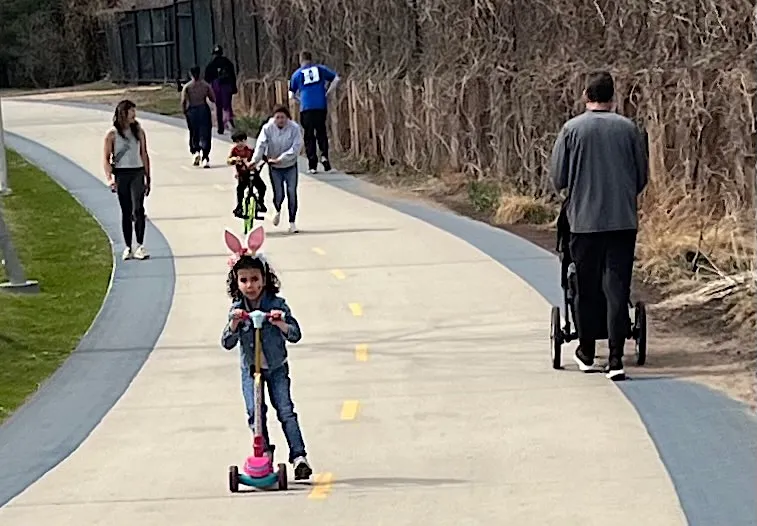
The value of car-free, off-street paths extends beyond recreation, offering crucial spaces for children to develop independence and the freedom to take calculated risks, according to a recent piece in Streetsblog Chicago. This perspective suggests a compelling argument for expanding such infrastructure in urban environments, drawing parallels that could resonate with London’s ongoing focus on improving public spaces and active travel.
The author, Jeremy Wolff, recounts personal experiences with car-free corridors like Chicago’s Bloomingdale Trail (the 606), Los Angeles’s Marvin Braude Bike Trail, and Atlanta’s BeltLine. These paths, converted from old rail lines or designed as linear parks, separate users from vehicular traffic. Wolff highlights how these environments allow children, such as his five-year-old nephew Kaden who was learning to ride a bike, to navigate with limited experience. Kaden’s occasional stops and tumbles were part of a safe learning process, made possible by the absence of cars and the forgiving surfaces of the trail.
Por que importa
“The trail offered something kids rarely get anymore: the freedom to make mistakes safely,” Wolff writes. This freedom is essential for fostering independence. When children can bike or scoot ahead, make their own directional choices, or even have a minor fall without immediate danger, they build confidence and decision-making skills. Wolff uses the example of a four-year-old named Matthew who independently chose his route along the BeltLine to a splash pad, experiencing a moment where “the city belonged to him.”
The argument posits that such trails are more than just amenities; they are critical infrastructure for childhood development. They encourage outdoor activity, combat isolation and inactivity, and can even support local businesses as trail users are more likely to stop and patronise establishments along the way. This contrasts with car-dependent travel, where people may “pass establishments without noticing them.”
Contexto
While the article focuses on the US context, the core principles have significant relevance for London. The city is actively pursuing strategies to enhance active travel, improve public realm, and create more child-friendly environments. The success of initiatives like the Queen Elizabeth Olympic Park’s extensive network of paths, or the numerous canal towpaths and disused railway lines adapted for public use, demonstrate a growing appreciation for car-free corridors.
The author points out that these trails often require “tremendous public and private cooperation to authorize, and require money to build and maintain.” Funding typically comes from transportation budgets, but the benefits are multifaceted, addressing social and health issues alongside mobility. Wolff suggests that current funding models may be fragmented, failing to capture the holistic benefits that trails offer in tackling isolation, inactivity, and economic stagnation simultaneously.
For London, this perspective could inform future planning decisions. As the city continues to develop new housing and regenerate areas, incorporating dedicated car-free corridors—whether elevated, at ground level, or along waterways—could be a strategic way to enhance the quality of life for residents, particularly families. The emphasis on providing children with safe spaces to explore and learn would align with broader goals of creating a more liveable and resilient city.
The article acknowledges the financial and logistical challenges in developing such infrastructure. However, it frames these investments as vital for community well-being and individual development, suggesting that underfunding them is a missed opportunity. The call to action is clear: “Kids need places to take risks without having to worry about being struck by drivers. Let’s build them trails.”
Key facts
| Aspect | Detail |
|—|—|
| Core Argument | Car-free off-street paths are essential for children’s safe risk-taking and independence. |
| Examples | Bloomingdale Trail (Chicago), Marvin Braude Bike Trail (LA), Atlanta BeltLine. |
| Benefits | Fosters independence, encourages activity, supports local businesses, improves well-being. |
| Challenge | Requires significant public/private cooperation and funding for development and maintenance. |
Applying this to London, the city’s numerous disused railway lines, canal towpaths, and potential for new linear parks present opportunities. While the specific context of Chicago’s 606 or Atlanta’s BeltLine may differ, the underlying principle of creating safe, car-free zones for active travel and personal development remains a powerful concept. As London plans for a future that prioritises active travel, public health, and community connection, the development of more such corridors could be a significant step forward. The focus on allowing children to make their own decisions and take small risks in a controlled environment is a compelling reason to advocate for their inclusion in urban design and planning.
Source: Streetsblog Chicago, “Car-free off-street paths give kids the freedom to risk making mistakes. That’s one reason we need to build more trails.”, https://chi.streetsblog.org/2026/06/22/car-free-off-street-paths-give-kids-the-freedom-to-risk-making-mistakes-thats-one-reason-we-need-to-build-more-trails
Datos clave
| Punto | Detalle |
|---|---|
| Fuente | Streetsblog Chicago |
| Fecha | 2026-06-23T00:37:04+00:00 |
| Tema | Car-free off-street paths give kids the freedom to risk making mistakes. That’s one reason we need to build more trails. |
Fuente
Streetsblog Chicago Publicacion original: 2026-06-23T00:37:04+00:00
Related updates

Seattle-Area Race Highlights Diverging Approaches to Housing, Transit and Tech Taxation
A Washington State legislative race in the 32nd District pits incrementalism against urgency on housing supply, transit funding and tech regulation, with…
Read update
New York court ruling on sanctuary policies carries implications for city-level immigration enforcement across the US
A federal judge has dismissed the Trump administration’s attempt to override New York City’s restrictions on immigration enforcement cooperation, citing state sovereignty.…
Read update
Automated license plate readers raise privacy, contract and oversight questions for UK cities
A new US-focused analysis of automated license plate recognition cameras highlights contract, privacy and oversight issues that London boroughs and Transport for…
Read update
Oregon’s “fix it first” dilemma: what London’s transport planners can learn from a revolt against megaprojects
Surveys show Oregonians overwhelmingly want existing roads repaired before new megaprojects are funded, and trust in the state’s transport agency has collapsed.…
Read updateWiki relacionada

Urban Planning Terms: Density, Public Realm and Transit-Oriented Development
A living glossary for terms that appear again and again in planning and development stories.
Read update