
World Cup 2026: A Catalyst for Safer Streets and Sustainable Transport in Host Cities
As North America prepares to host the 2026 FIFA World Cup, the event presents a critical opportunity to advance urban mobility, focusing on public transport, road safety, and sustainable travel options beyond the tournament's duration.
The 2026 FIFA World Cup, co-hosted by Mexico, the U.S., and Canada, is poised to be more than just a global sporting spectacle. It presents a significant opportunity to address critical urban mobility challenges across North America, with a particular focus on enhancing public transport, improving road safety, and fostering sustainable travel habits. As millions of residents and visitors navigate host cities between stadiums, hotels, and public spaces, the tournament’s success hinges on efficient and safe transportation systems.
The legacy of major international events can extend far beyond iconic venues and memorable moments. When strategically planned, these events can spur vital investments in public transport and safe mobility infrastructure that benefit communities for decades. For the numerous host cities, especially in Mexico and the U.S., the World Cup arrives at a crucial juncture. Growing urban populations, worsening congestion, and the significant contribution of transport to greenhouse gas emissions necessitate a shift away from private vehicle dependency and fossil fuels.
Por que importa
Public transport, particularly electric public transport, is identified as a key solution. Moving vast numbers of people via large, polluting vehicles is neither practical nor sustainable for high-demand events. High-capacity systems such as Bus Rapid Transit (BRT), commuter rail, and electric bus fleets offer a more efficient and environmentally friendly alternative, capable of reducing congestion, improving air quality, and lowering emissions. Investments made for the World Cup can directly support cities in achieving long-term climate, public health, and mobility objectives.
Historically, major international events have served as catalysts for public transport development, from Barcelona to Shanghai. The World Cup provides a platform to accelerate projects that might otherwise face lengthy development timelines. Rather than treating these investments as temporary expenditures, cities can leverage them as foundational elements for a cleaner, more resilient transport future.
Contexto
In Mexico, host cities like Guadalajara, Mexico City, and Monterrey are expected to welcome a substantial influx of visitors. This surge in travel demand around stadiums and key hubs presents both opportunities and risks. In response, ITDP Mexico, in collaboration with partners including the FIA Foundation, is actively promoting road safety and sustainable mobility.
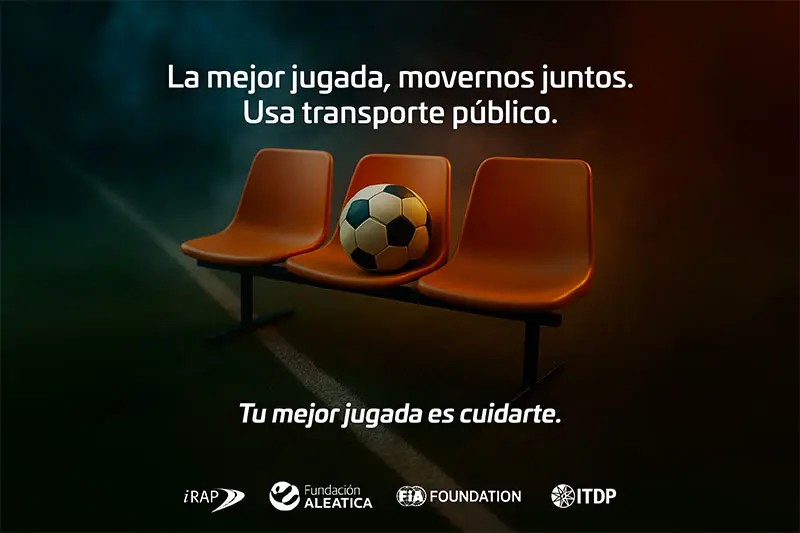
The “Tu Mejor Jugada es Cuidarte” (“Your Best Move Is to Take Care of Yourself”) campaign, a collaborative effort involving the Aleatica Foundation, FIA Foundation, ITDP Mexico, and iRAP, is working with government agencies and civil society to encourage safer and more sustainable travel choices. This includes promoting the use of electric buses, walking, and cycling, while also raising public awareness about risky behaviours such as speeding and impaired driving. Public awareness efforts are visible across multiple platforms, including billboards, transit stops, and digital channels.
Beyond public communication, this initiative is instrumental in strengthening long-term mobility planning. ITDP Mexico and its partners are conducting road safety assessments in the three host cities to identify infrastructure improvements and reduce crash risks. They are also supporting the development of mobility plans that prioritize public transport, enhance pedestrian access, and improve cycling networks. The overarching goal is to create a lasting legacy of safer and more sustainable streets.
The ultimate measure of success for these World Cup mobility investments will not solely be the efficiency of fan travel to stadiums. It will be determined by whether these investments leave cities with transport systems that are demonstrably safer, cleaner, and more equitable than before the tournament. Public funds allocated for event preparations should yield long-term value for residents, particularly for communities that have historically lacked access to reliable and affordable transport. The enduring legacy of this World Cup, and future events, should be the improved public transport and street infrastructure that remains for everyone.
Key facts
| Aspect | Details |
|---|---|
| Event | 2026 FIFA World Cup |
| Host Nations | Mexico, U.S., Canada |
| Focus Areas | Public transport, road safety, sustainable mobility |
| Key Initiatives | “Tu Mejor Jugada es Cuidarte” campaign, road safety assessments |
| Implementing Bodies | ITDP Mexico, FIA Foundation, Aleatica Foundation, iRAP, government agencies |
Source: The 2026 World Cup Is a Chance to Spotlight Safer Streets and Better Transport – ITDP (https://itdp.org/2026/06/16/2026-world-cup-spotlight-safer-streets-and-better-transport/)
Fuente
ITDP Publicacion original: 2026-06-16T17:35:20+00:00
Related updates
Seattle social housing land deal offers lessons for London’s community-led delivery
Seattle’s social housing developer has acquired its first site for a mixed-income project, aiming for 1,000 homes by end of 2026. The…
Read update
When zoning reform meets private covenants: the HOA obstacle to backyard cottages
As more US cities rewrite zoning rules to allow accessory dwellings, private homeowners’ association covenants remain a barrier that reform alone cannot…
Read update
Seattle-Area Race Highlights Diverging Approaches to Housing, Transit and Tech Taxation
A Washington State legislative race in the 32nd District pits incrementalism against urgency on housing supply, transit funding and tech regulation, with…
Read update
New York court ruling on sanctuary policies carries implications for city-level immigration enforcement across the US
A federal judge has dismissed the Trump administration’s attempt to override New York City’s restrictions on immigration enforcement cooperation, citing state sovereignty.…
Read updateWiki relacionada
Urban Planning Terms: Density, Public Realm and Transit-Oriented Development
A living glossary for terms that appear again and again in planning and development stories.
Read update